|
|
|
 |
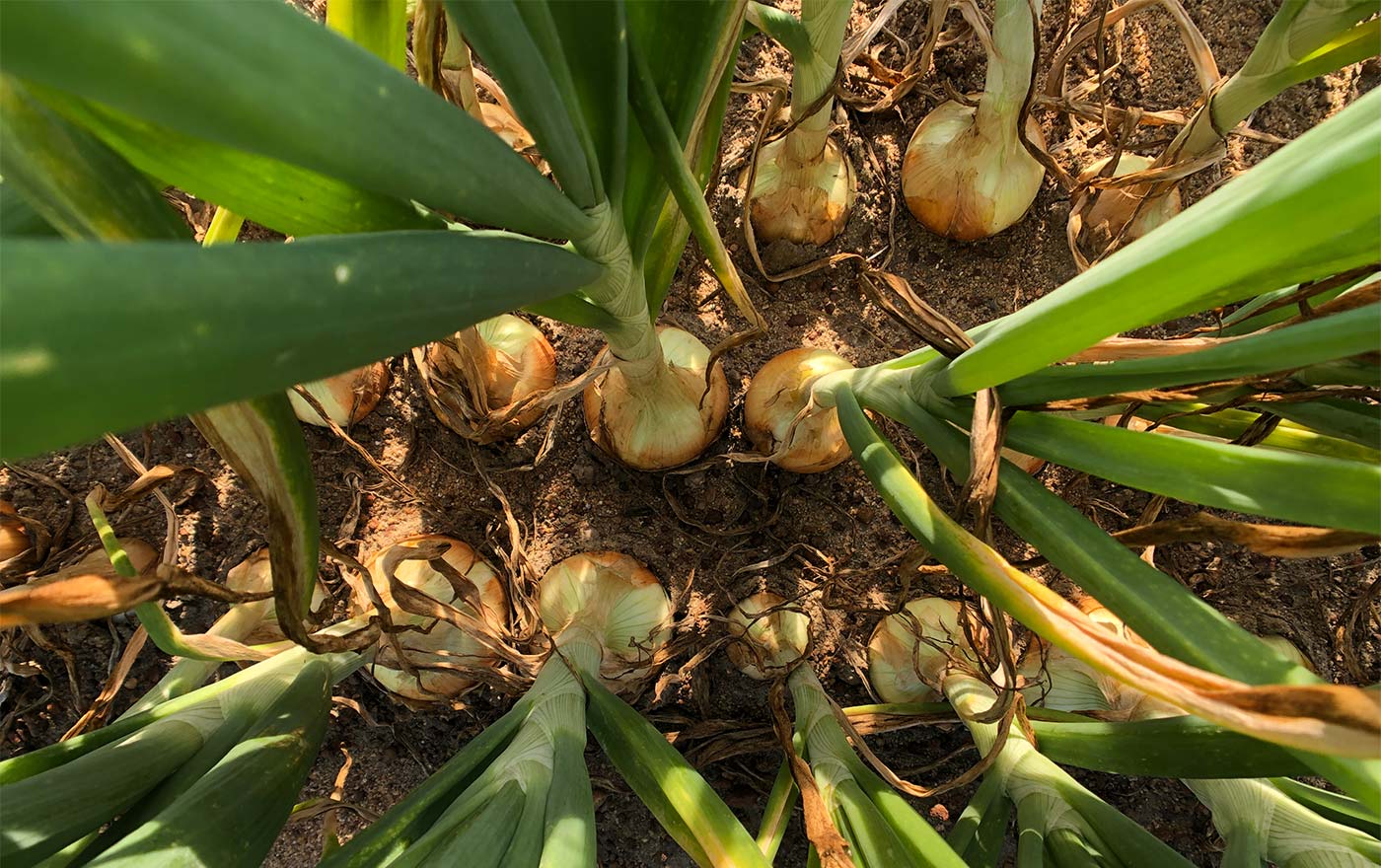
Similar onions are grown in other parts of the country, but the
combination of sandy soil and mild climate provide the Vidalia ®
onion with its distinct flavor.
Vidalia ® onions are a good source of vitamin C and dietary
fiber. |
|
|
 |
| |
A BUYERS GUIDE TO VIDALIAS ® |
|
| |
- Vidalia ® onions should have a light, golden-brown
exterior and a milky white interior. They should be
rounded on the bottom and slightly flat on top.
- Vidalia ® onions bruise fairly easily, so handle them
with care.
To enjoy Vidalia ® onions longer than the 10-12 weeks
they're available each year, buy in large quantities and
store them properly.
- Keep Vidalia ® onions cool, dry and separate to ensure
they stay fresh.
- Or, store them in the legs of old, clean, sheer
pantyhose. Tie a knot between each onion, and cut the
knot when you are ready to use it. Hang Vidalia® onions
in a cool, dry, well ventilated area.
- Vidalia ® onions also can be stored on racks or screens
as long as they don't touch and are kept in a cool place.
- To freeze a whole Vidalia ® onion, peel, wash, core and
place onion in freezer bag. Frozen onions should be used
for cooking, because freezing changes their texture.
|
|
| |
 |
|
|
|
Vidalia Onion Story
The Vidalia Onion Story takes root in Toombs County, Georgia
over 60 years ago, when a farmer by the name of Moses Coleman discovered in the late spring
of 1931 the onions he had planted were not hot, as he expected. They were sweet! It
was a struggle to sell the onions at first, but Moses persevered, and managed to sell them
for $3.50 per 50-pound bag, which in those days was a big price.
Other farmers, who through the Depression years had
not been able to get a fair price for their produce, thought Coleman had found a gold
mine. They began to follow suit, and soon after, their farms were also producing the
sweet, mild onion.
In the 1940's, the State of Georgia built a
Farmer's Market in Vidalia, and because the small town was at the juncture of some of
South Georgia's most widely traveled highways, the market had a thriving tourist business.
Word began to spread about "those Vidalia onions". Consumers, then, gave the
onions their famous name. Reorders were made, and "Vidalia Onions" began
appearing on the shelves of Piggly Wiggly and A & P grocery stores. Through the
1950s and 60s, production grew at a slow but steady pace, reaching some 600 total acres by
the mid 1970s. At that point, a push was made for Vidalia Onions to be distributed
throughout the nation, and several promotional efforts were begun. Onion festivals became
an annual event in both Vidalia and nearby Glennville, Georgia, and production grew
tenfold over the next decade.
In 1986, Georgia's state legislature passed
legislation giving the Vidalia Onion legal status and defining the 20-county production
area. The Vidalia Onion was named Georgia's Official State Vegetable by the state
legislature in 1990.
In 1989, Vidalia Onion producers united to
establish Federal Marketing Order No. 955 for the crop. This USDA program established the
Vidalia Onion Committee and extended the definition of a Vidalia Onion to the Federal
level. The Marketing Order provided a vehicle for producers to jointly fund research and
promotional programs.
Beginning in 1990, technology borrowed from the
apple industry was adapted to begin the controlled atmosphere (CA) storage of Vidalia
Onions. Now some 20,000,000 pounds of Vidalia Onions can be put into CA storage for up to
six months, thus extending the marketing of the Vidalia's
through the fall and into the
holiday season.
In 1991, the Vidalia Onion Committee began to
annually honor one individual with introduction into the Vidalia Onion Hall of Fame. The
committee considers the recipient's character, reputation and overall contribution to the
growth and success of the Vidalia Onion. Inductees must be a leader in one or more of the
following areas: protecting and promoting the name of the Vidalia Onion; protecting and
promoting the quality of the Vidalia Onion; advertising and promoting the Vidalia Onion;
sales of Vidalia Onions and creative selling methods; or research and growth development
of the Vidalia Onions.
We hope you enjoy Vidalia's...one of Georgia's
many treasures.
Back to Top of Page
History and Origin of the Onion
Onions are
difficult for archaeologists to track because they are too small and
their tissues leave little, if any, trace. Some food historians place
the earliest onion cultivation at the edges of the Mediterranean as long
ago as 5,000 years. Others believe that onions originated in central
Asia. The National Onion Association says onions were first grown in
Iran and Pakistan. It's difficult to say in which area onions originated
as several hundred varieties of onions grow wild in temperate climates
all around the world.
The Egyptians left
onions in their tombs about 3,500 years ago. In fact, the mummy of King
Ramses IV, who died in 1160 B.C., had small onions in the eye sockets,
probably because they had some spiritual significance and because they
replicated a real eyeball. Paintings of onions appear on the inner walls
of the pyramids of Unas (c. 2423 B.C.) and Pepi II (c.2200 B.C.), and in
tombs of both the Old Kingdom and the New Kingdom.
The Roman satirist
Juvenal wrote of the Egyptians:
How Egypt, mad
with superstition grown,
Makes gods of monsters but too well is known.
'Tis mortal sin an Onion to devour,
Each clove of garlic hath a sacred power,
Religious nation sure, and best abodes,
When every garden is o'errun with gods!
Many early
documents tell of onion cultivation and use. There is evidence that the
Sumerians were growing onions as early as 2500 B.C. The great food
historian, Waverly Root, cites a Sumerian text dated to about 2400 B.C.
that tells of someone plowing of the city governor's onion plot.
Three different
varieties of alliums (onions) are mentioned to have been eaten by the
Israelites in the Biblical book Numbers; leeks, onions and
garlic.
The Roman writer
Pliny the Elder wrote of onions grown in Pompeii. When Pompeii was
excavated, archaeologists found cavities in the gardens where the onion
bulbs had grown, just as he had written.
Texts from India
dated to the early 6th C. write of the onion's use as
medicine. They were used as a diuretic, and taken for the heart, the
eyes and the joints.
The onions we use today are very similar to
those described and eaten 2000 years ago. By 1900, plant breeders were
already refining the species to meet the needs of the grower and
consumer. A 1900 seed catalog might offer red, yellow, white, oblate,
globe and spindle shaped onions.
The accidental discovery of a male-sterile
onion by the botanist Henry Jones in 1925 marked the beginning of modern
onion breeding. Crossing the sterile line of onions with other onions
having desirable characteristics could produce new and better hybrids.
Cooperative breeding programs began at universities all across the
country. The result was that onion varieties were developed for specific
and varied growing conditions.
Onion breeders have been able to strengthen
the plant's resistance to many diseases. It is now possible to plant
varieties that are not only immune to most diseases but are resistant to
diseases prevalent in certain types of geographic areas. For example,
researchers in Wisconsin were able to breed for onions containing more
phenol. Phenol, when it is diluted, is carbolic acid. Carbolic acid can
be used to protect onions from smudge, a naturally occurring mold-like
condition.
The complex role of day-length in onion
bulb development was another important factor in breeding onion
varieties. Many onion varieties were developed which would form bulbs at
the correct time, i.e. varieties for both northern and southern growers.
In 1945, analysis of the sulfur compounds
in onions (the compound that makes people cry when an onion is cut)
resulted in breeders being able to develop a sweet onion. These onions
are spring and summer onions, high in water and sugar content, and known
for their sweet mild flavor. They don't store as well as other onion
varieties do, but they offer a distinctive variation in flavor and have
become very popular.
Today, most of the onions eaten in North
America are storage onions, grown primarily in western Idaho and eastern
Oregon. As much as a quarter of the U.S. fall and winter crop of storage
onions is produced in this area. California produces an equivalent
amount, another 25% of America's onions, and not just storage onions,
but also sweet, speciality, and processing onions. In fact, half of
California's onion production goes to processors. Other states produce
substantially lesser amounts. Texas grows about 10% of the total onion
acreage, mostly sweets; Georgia grows about 5%. New Mexico, Washington,
and Arizona also produce substantial quantities of sweets. Colorado, New
York, Michigan, Wisconsin, Nevada, Utah, Nebraska and Ohio are also
onion-growing states.
There are onion varieties for every climate
and latitude, large and small, hot and sweet, ready to eat and storage
types. So many varieties, so many producing areas. There should never be
a time when onions cannot be found in any supermarket.
|